AI for Municipal Operations: A Responsible Implementation Guide
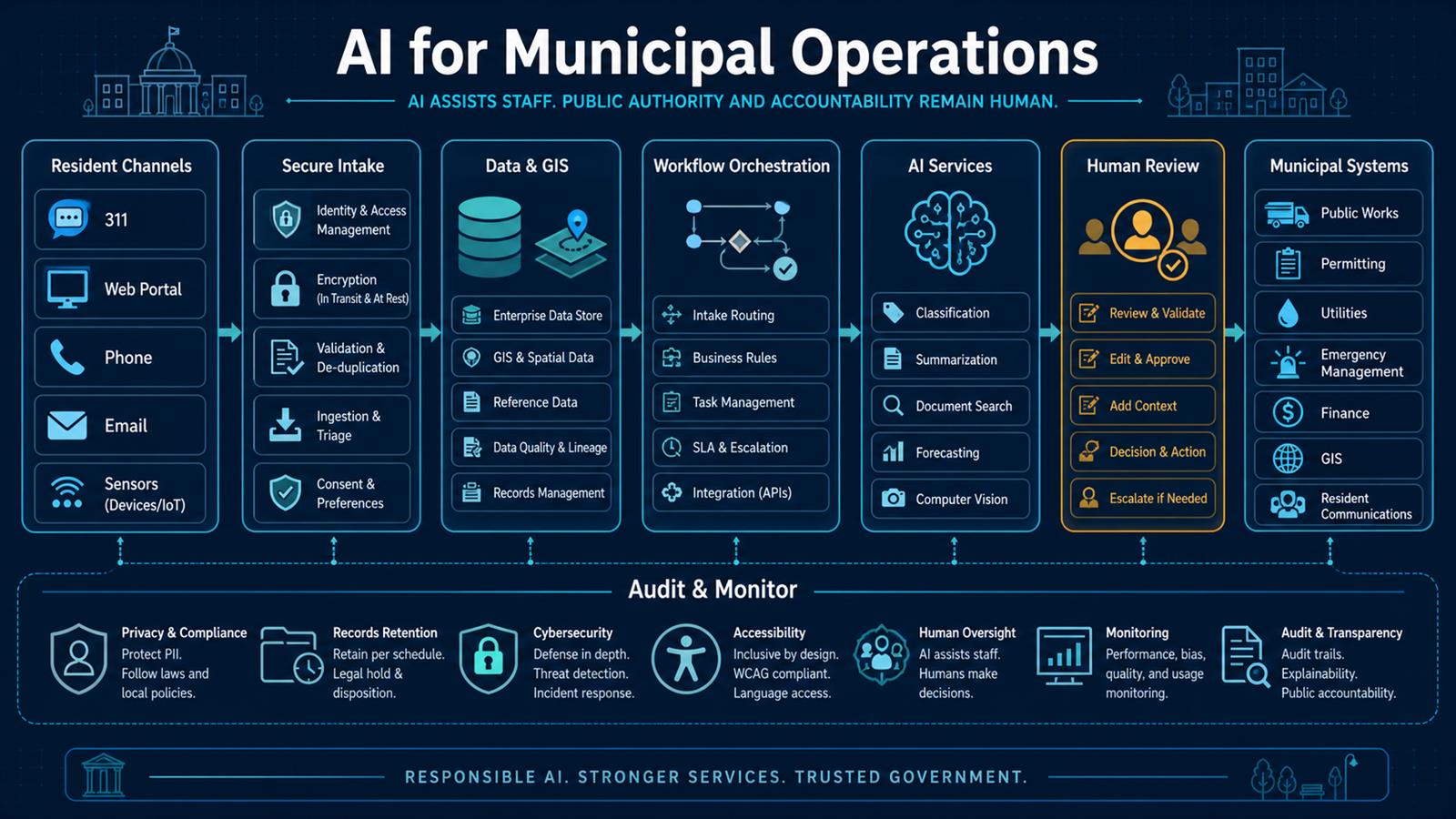
Municipal governments manage high-volume work with limited staff: service requests, permits, inspections, public records, infrastructure maintenance, utilities, budgeting, emergency coordination, and resident communications. AI can help organize information and accelerate routine work, but it must operate inside public-sector rules for privacy, accessibility, records, security, transparency, and human authority.
Problem
Residents contact government through 311, phone, email, portals, meetings, and social channels. Staff often re-enter information across disconnected systems, search long documents, classify requests manually, and assemble reports from spreadsheets. Important context may be buried in free text, scanned files, maps, photographs, and departmental databases.
Uncontrolled AI creates a different problem. A chatbot may provide an incorrect answer, a model may reproduce bias in historical data, sensitive information may leave an approved boundary, or an automated recommendation may become an unexplained government decision. Municipal adoption must improve operations without weakening due process or public trust.
Why it matters
Operational delays affect road repairs, permits, utility response, constituent service, and employee workload. Better triage and information retrieval can reduce backlogs and help staff focus on cases that require expertise. Consistent data also improves resource planning and elected-official reporting.
Government decisions carry obligations that private productivity tools may not address: public records retention, open meetings, procurement, civil rights, accessibility, cybersecurity, appeals, and explainability. These requirements should shape the architecture from the beginning rather than being added after a pilot.
Solution
Start with bounded assistive use cases. Use AI to classify service requests, summarize case history, search approved documents, extract fields, draft plain-language communications, detect visible infrastructure conditions, or forecast workload. Keep policy decisions, enforcement, eligibility, payment, legal determinations, and other consequential actions under authorized human control.
Place workflow orchestration between public channels, governed municipal data, AI services, and systems of record. Deterministic business rules validate inputs, permissions, deadlines, and status transitions. AI handles language or visual interpretation. Staff review outputs with source evidence before taking action, and monitoring records performance, errors, overrides, and public impact.
Architecture
311 / Portal / Phone / Email / Sensors
                    ↓
 Secure intake, identity, consent, validation
                    ↓
    Enterprise data + documents + GIS
                    ↓
 Workflow orchestration and business rules
                    ↓
 AI: classify / extract / summarize / search /
     forecast / analyze approved imagery
                    ↓
 Confidence, policy, and risk checks
             ↙                ↘
      Human review         Exception queue
             ↘                ↙
 Public works / Permitting / Utilities /
 Emergency management / Finance / CRM / GIS
                    ↓
 Resident update + system-of-record entry
                    ↓
 Audit, records retention, quality monitoring
Example workflow
Consider a resident reporting a roadway problem:
Resident submits description, location, and photo
     ↓
Workflow validates contact preferences and address
     ↓
GIS converts location to road segment and jurisdiction
     ↓
AI classifies issue and summarizes the report
     ↓
System checks for nearby duplicate requests
     ↓
Rules assign priority from approved criteria
     ↓
Public works employee reviews photo and recommendation
     ↓
Work order created in maintenance system
     ↓
Resident receives accessible status updates
     ↓
Completion, response time, and overrides are audited
The model does not decide whether a road is safe or whether funds should be committed. It organizes evidence and proposes routing. Staff apply policy, inspect conditions when needed, and remain accountable for the action.
Technology Stack
- Resident service platform or CRM: requests, contacts, status, and communications.
- n8n or governed workflow platform: orchestration, integrations, retries, escalation, and audit events.
- GIS: addresses, assets, parcels, jurisdictions, routes, and spatial analysis.
- Document and records systems: approved policies, case files, retention, legal holds, and disposition.
- OpenAI or approved models: classification, extraction, summarization, search, and drafting.
- Computer vision: bounded analysis of approved images with documented validation.
- APIs and data platform: secure access to systems of record and reference data.
- Identity, security, and monitoring: least privilege, encryption, logs, incident response, quality, and cost controls.
Implementation
1. Select a bounded operational problem
Choose a frequent task with measurable delay, available data, and a staff owner. Avoid beginning with benefits, enforcement, public safety dispatch, or another high-consequence decision. Define the current baseline and desired service improvement.
2. Map authority and public obligations
Identify applicable laws, ordinances, labor agreements, procurement rules, records schedules, privacy requirements, accessibility standards, cybersecurity policy, due-process protections, and approval authority. Involve legal, records, security, accessibility, operations, and affected staff early.
3. Inventory data and establish purpose limits
Document sources, owners, sensitivity, quality, retention, sharing restrictions, and permitted purpose. Minimize personal information, separate test from production data, and prevent model providers from using municipal data beyond approved terms.
4. Define human decision points
Specify what AI may suggest, what rules may automate, and what requires staff approval. Define low-confidence, conflict, sensitive-data, and unusual-case thresholds that send work to review. Give employees a clear way to disagree with the model.
5. Build a governed integration layer
Use APIs and workflow credentials with least privilege. Validate payloads, normalize identifiers, apply business rules, store idempotency keys, retry transient failures safely, and write final actions to the authoritative municipal system.
6. Ground outputs in approved sources
For document questions, retrieve from a curated corpus and require citations to policy, ordinance, procedure, or case material. Show source date and version. The system should say when evidence is insufficient instead of inventing an answer.
7. Design for accessibility and language access
Keep essential services available through non-AI channels. Test interfaces, generated content, documents, and notifications for accessibility and plain language. Validate translations with qualified reviewers for critical communications.
8. Test security and adversarial behavior
Test prompt injection in resident text and documents, data exfiltration, unauthorized tool calls, malicious files, identity failures, excessive permissions, model outages, and denial-of-service costs. Do not allow untrusted content to redefine system instructions or approval rules.
9. Evaluate quality across communities
Use realistic cases from different neighborhoods, languages, channels, document qualities, and request types. Measure false routing, missed urgency, hallucinations, staff overrides, accessibility failures, and unequal performance—not only average accuracy.
10. Pilot with shadow mode
Run recommendations alongside the existing process before allowing automation to change records or contact residents. Compare outputs with staff decisions, correct data and rules, train employees, and publish clear operating procedures.
11. Create audit and records controls
Record input references, source versions, model and prompt configuration, rule results, staff decisions, overrides, generated communications, and downstream actions. Apply approved retention and public-records procedures without logging unnecessary sensitive content.
12. Monitor service and public impact
Track cycle time, backlog, accuracy, confidence, exceptions, overrides, complaints, accessibility, security events, costs, and outcomes by relevant service dimensions. Establish rollback triggers, periodic review, vendor-change review, and a method for residents to reach a person.
Benefits
- Time savings: faster triage, document review, data entry, and report preparation.
- Money savings: fewer repetitive tasks and better targeting of limited operational resources.
- Error reduction: consistent validation, routing, citations, and duplicate checks.
- Resident experience: quicker acknowledgements, clearer status, accessible communications, and fewer transfers.
- Staff capacity: employees spend more time on inspections, judgment, engagement, and complex cases.
- Accountability: decisions, evidence, overrides, and system behavior remain reviewable.
Where municipalities should start
Strong early candidates include internal document search, meeting or case summarization, service-request classification, duplicate detection, staff drafting assistance, and operational forecasting. The goal is not an “AI city.” It is a series of well-governed improvements that solve real service problems and earn trust through evidence.
Read also
- The Complete Guide to AI Automation
- Document Approval with AI
- Practical AI: Where to Start
- What Is an AI Agent?
Need help implementing this? Contact Jupabequi for a free consultation.